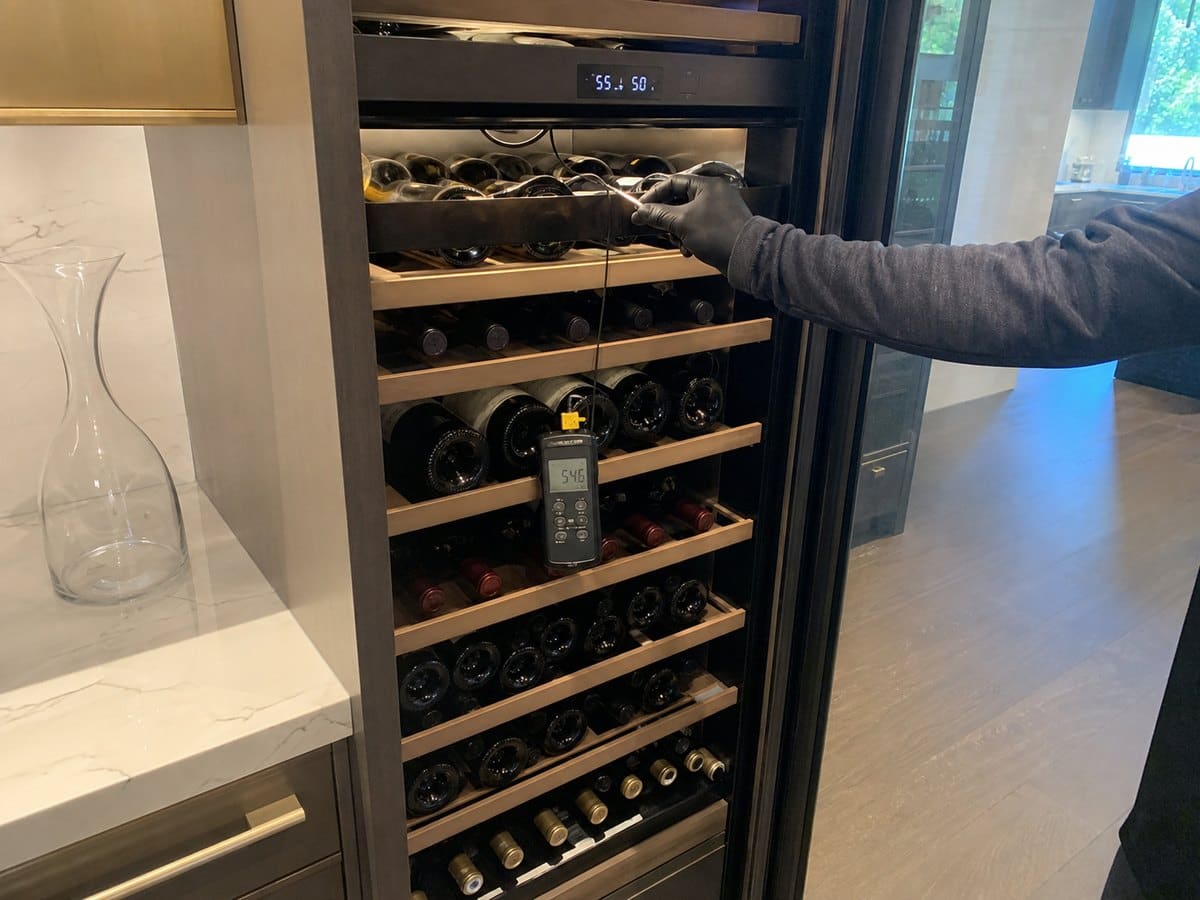
The upper wine zone drifted to 59°F while the lower zone held 45°F. They compared the display to an independent probe, replaced the upper thermistor and verified both zones for 40 minutes. The $485 repair protected a small collection without moving the bottles.
Specialty · Wine storage
Wine column drifting several degrees

Diagnostic matrix
Read the drift before any trust talk
We start with the matrix, not a sales pitch. This is the order we test a drifting wine column:
| Symptom | Likely component | Confirmation test | Repair path |
|---|---|---|---|
| One zone warm, one holds | Zone thermistor out of spec | Compare display vs independent probe | Serial-matched sensor; re-verify zones |
| Both zones swinging | Damper or control timing | Damper movement & control signal | Free/replace damper; confirm stability |
| Display alarm or odd readout | Control board / sensor | Read code & sensor values by model | Matched board or sensor; clear & verify |
| Slow recovery after door open | Airflow / fan | Fan operation, evaporator temp | Fan service; confirm pull-down time |
| Condensation inside the cabinet | Seal / humidity | Gasket contact & door fit | Gasket or reseat; recheck humidity |
Not a generic repair
Why wine storage is its own discipline
A wine column is engineered for stability, not just cold: tight tolerance, low vibration, controlled humidity and independent zones for reds and whites. That is why a "few degrees" matters far more than it would in a kitchen fridge, and why a control board, thermistor or display alarm here is read carefully rather than reset away. In plain terms: the unit's brain compares each zone's sensor to its set point and drives a damper and fan to hold it; when a sensor reads high, the control over-cools, and when it reads low, the zone drifts warm. What confirms which way it has failed is a side-by-side with a calibrated probe — the one thing we cannot infer from the front display alone, because the display is reporting the very sensor we are testing.
Five common failures
What changes the quote
Zone thermistor drift
Part-level fix; quote depends on whether one or both zone sensors are out.
Sluggish damper
Mechanical; freeing it is minor, replacing it is moderate.
Control board fault
Serial-specific board; availability and revision drive the cost.
Evaporator fan / airflow
Affects recovery time; modest part, quick verify.
Seal / humidity loss
Gasket or reseat; ties into a door-seal repair.
Your call
When to schedule, when to pause use
If the drift is small and steady, schedule a diagnosis but you can keep the bottles in place. If a zone is swinging widely or reading well off set point, move valuable wine to stable storage until it is fixed — repeated swings do more harm than a single steady offset. Call or book online for the service window; the technician verifies model, serial, set point and actual temperature during the visit. As a trust point: the evidence we work from is the same the manufacturer would — measured temperature readings, condenser and evaporator observations, model-tag proof, and OEM fan, gasket or control-board confirmation — even when the original complaint is just "the fridge side feels warm" and the real story is a fresh-food section warm while the freezer still holds on a combination unit.
Local proof
Where wine storage clusters
Wine columns are dense in Montclair Village remodels and the hillside homes of Piedmont Pines, Merriewood and Glen Highlands, where damp, wooded lots make a controlled cabinet worth having. Down in Piedmont, larger collections in finished cellars raise the stakes on stability. Each setting changes access and urgency: a furniture-fit column in a tight Merriewood run takes planning to service, while a freestanding unit in a Piedmont cellar is easier to reach but holds more wine at risk.
My wine column is a few degrees off — is that urgent?
For a collection, yes — sustained drift and temperature swings are what harm wine. Mechanically it is usually a part-level fault (thermistor, damper or control), not a failed system, so it is worth diagnosing promptly before the swings widen.
One zone is fine and the other drifts. Why?
Dual-zone columns control each zone independently, so a single failed sensor or sluggish damper drifts one zone while the other holds. We confirm which zone is mis-reading against an independent probe before replacing a part.
Could it be the control board rather than a sensor?
Sometimes. A control board, thermistor or display alarm can all present as drift. We read the values and the alarm history and verify against measured temperatures so we replace the part that is actually wrong, not the easiest one to reach.
How should I schedule wine-column service?
Call or book online. During diagnosis, the technician verifies the model and serial, compares set point to actual temperature and checks the drifting zone with an independent probe.
FAQ
Questions this page should answer
My wine column is a few degrees off — is that urgent?
For a collection, yes — sustained drift and temperature swings are what harm wine. Mechanically it is usually a part-level fault (thermistor, damper or control), not a failed system, so it is worth diagnosing promptly before the swings widen.
One zone is fine and the other drifts. Why?
Dual-zone columns control each zone independently, so a single failed sensor or sluggish damper drifts one zone while the other holds. We confirm which zone is mis-reading against an independent probe before replacing a part.
Could it be the control board rather than a sensor?
Sometimes. A control board, thermistor or display alarm can all present as drift. We read the values and the alarm history and verify against measured temperatures so we replace the part that is actually wrong, not the easiest one to reach.
How should I schedule wine-column service?
Call or book online. During diagnosis, the technician verifies the model and serial, compares set point to actual temperature and checks the drifting zone with an independent probe.
What wine temperature swing is enough to call for diagnosis?
A steady offset of 1-2°F can be watched, but a zone that drifts more than 3°F for 24 hours or swings repeatedly should be checked. The technician compares the display to an independent probe before naming a thermistor, damper or board.
Does a tight Merriewood wine column change the service plan?
Yes. Furniture-fit wine columns in Merriewood or Piedmont Pines may need extra access planning even for a part-level $385-$1,280 sensor or control repair. The model, serial, door swing and zone readings are documented before parts are ordered.
Last updated: 2026-06-05. Planning ranges are estimates; the final quote depends on model, access, diagnosis and part availability.

Reviews
Wine-column temperature repair outcomes
Our dual-zone column swung 5°F after every door opening. The technician tested damper movement, matched the part to the serial and corrected the zone in 3 hours. The written price was $695 and the probe held within 1°F afterward.
A.M., Montclair Village
A display alarm made us suspect the board, but the probe showed one sensor reading wrong. They replaced the sensor, cleared the alarm and logged 54°F in the red zone. The visit cost $575, far below a control-board quote.
Homeowner, Piedmont Pines
Montclair service
Planning ranges and service area
Local entity: Montclair means the Montclair neighborhood of Oakland, California in Alameda County, including 94611 and 94618, not Montclair, New Jersey.
- A Sub-Zero wine zone that drifts more than 3°F for 24 hours should be checked with an independent probe before a thermistor, damper or board is named.
- Typical Montclair wine-column sensor, damper or control diagnosis range: $385-$1,280, usually 1-4 hours plus any serial-specific part lead time.
- Merriewood and Piedmont Pines wine columns often sit in tight furniture-fit runs, so access and zone readings are documented before parts are ordered.
| Service / symptom | Planning price range | Typical time | What is included |
|---|---|---|---|
| Diagnostic / service call | $135-$205 | 45-90 min | Includes onsite model verification, temperature readings, condenser airflow and visual cabinet checks. |
| Evaporator or condenser fan / damper | $365-$825 | 1-3 hours | Covers airflow testing, serial-matched fan or damper work and post-repair temperature recovery. |
| Door gasket / frost-line repair | $365-$885 | 1-3 hours | Depends on exact gasket profile, hinge alignment and cabinet fit. |
| Ice maker / water line repair | $295-$875 | 1-3 hours | Separates inlet valve, fill tube, filter, module and temperature-side causes. |
| Control board / sensor diagnosis | $385-$1,280 | 1-4 hours | Quoted only after electrical evidence and serial revision check. |
| Cabinet-safe pull-out / reseat support | $215-$975 | 1-4 hours | Applies when panel-ready access, floor protection, water shutoff or two-person staging is needed. |
| Compressor / sealed system | $1,420-$3,475 | 2-6 hours plus parts | Requires pressure/electrical evidence before quoting refrigerant or compressor work. |
Final price is set by the model and serial, cabinet access, verified readings, part revision and whether the first visit proves a part-level repair or sealed-system work.
Last updated: 2026-06-05. Planning ranges are estimates; the final quote depends on model, access, diagnosis and part availability.