
★★★★★
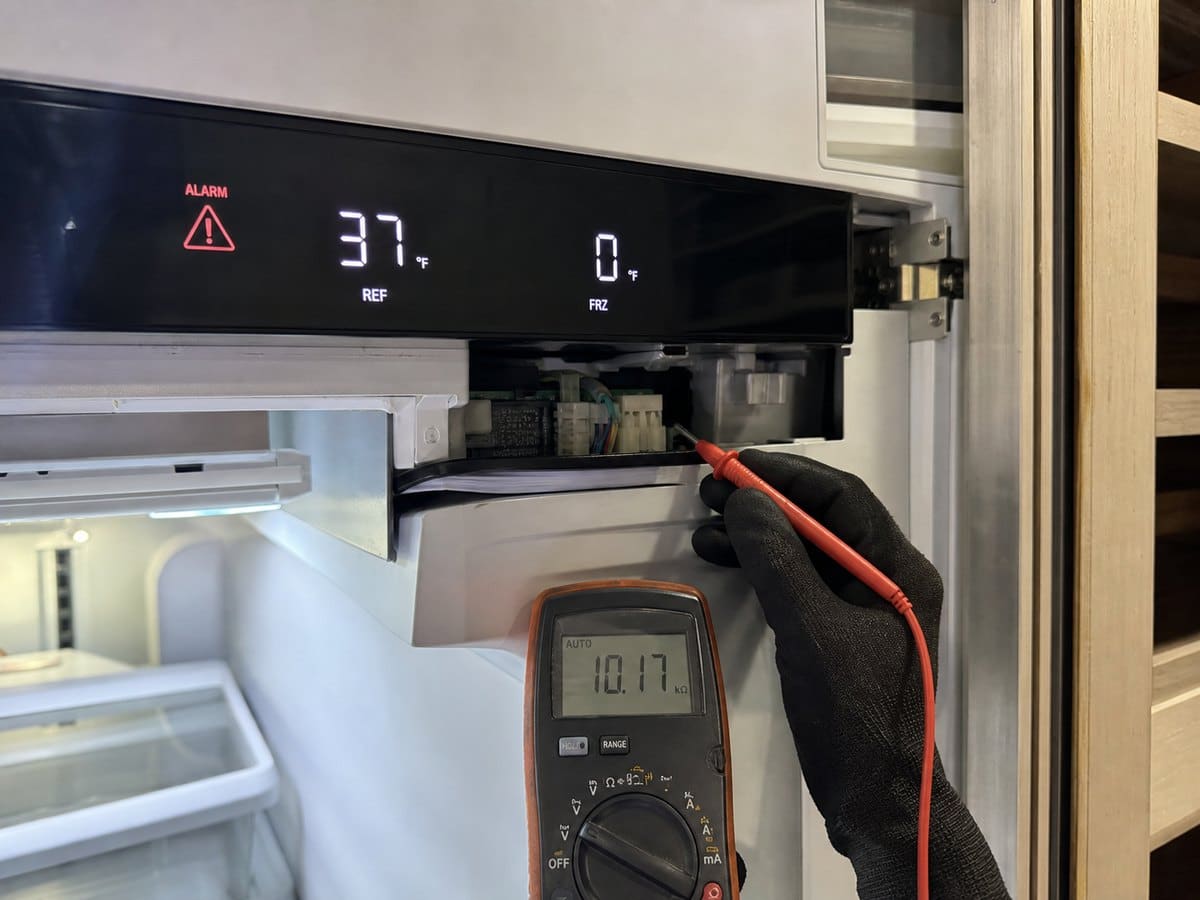
Our display alarm kept returning after foggy mornings. They wrote down the code, compared actual temperatures and found a thermistor reading off by several degrees. The sensor replacement was $515, took 2 hours and the alarm has not returned.
Technical · Codes & alarms
Sub-Zero alarms are read by your model and serial, not a generic chart, because the same flashing or solid "Service" light, "Vacuum Condenser" reminder, door-ajar or over-temp warning can mean different things by revision. Around Montclair Village we pair the display with measured °F and sensor values before naming a part.
Quick reference
Use this as an honest starting point only. Sub-Zero shows behaviors and indicators more than bare numbers, and the exact meaning is set by your model and serial — verify before buying a part.
| Alarm / display behavior | What it usually points to | What to do |
|---|---|---|
| Flashing or solid "Service" indicator | A stored fault, sensor or control-board condition the unit logged | Photograph the exact display and verify by model/serial; do not keep clearing it |
| "Vacuum Condenser" reminder or unusually long run times | A packed condenser — common in Forestland and Oakmore where damp canyon air pulls in dust and ash | Pull the grille, clean the coil, then re-probe temperatures before assuming a part |
| Frost or condensation at the door after foggy mornings | A gasket or seal letting marine air in around 94611 | Run a paper-drag test along the seal; replace the gasket only if it slips |
| High-temp / over-temp alarm after a long door-open | Normal recovery, or a marginal sensor if it will not settle | Let it run a full cycle, confirm °F, then re-probe if the alarm stays |
| Fresh-food section warm while freezer holds | Evaporator fan, frosted coil or a stuck air damper | Check airflow and the fan; have the damper and defrost path verified onsite |
| Blank or frozen display; newer EC-style messages | Display, a connector, the power supply or a board fault | Read sensor values and connections first; treat EC-style text generically and verify by model/serial |
In Forestland and across 94611, a Montclair Sub-Zero alarm is read against your model and serial, never a generic chart, because exact code meanings are revision-specific. Montclair Sub-Zero Repair pairs the display flag with measured temperatures and the thermistor or control values. Seeing a code now? Call (510) 390-9712.
Safe vs not
Safely owner-checkable: read and write down exactly what the display shows, whether a door was left open, whether the filter indicator is on, and whether temperatures are actually off. Those rule in or out the advisory alarms. What needs a trained technician: anything pointing at a sensor, the control board, the sealed system or a gas-valve path. A plain-language example of the second kind is a wine column drifting several degrees with a display alarm — what confirms it is comparing the suspect zone sensor to an independent probe, and what we cannot know beforehand is whether the sensor, the damper or the board is the actual fault until those values are read.
Diagnostic table
| Indication | Possible component | Confirmation test | False positive to avoid | Repair path |
|---|---|---|---|---|
| High-temp alarm after long door-open | None (advisory) | Check temps recover on their own | Servicing a unit that just needs time | Monitor; no repair if it recovers |
| Persistent high-temp alarm | Airflow / fan / sensor | Evaporator temp & fan operation | Blaming the board before the fan | Fan / defrost / sensor as confirmed |
| Filter / maintenance indicator | Water filter | Filter age | Treating it as a fault | Replace filter; reset indicator |
| Ice fault flag | Inlet valve / fill / module | Fill volume & module cycle | Replacing the module first | Water-side fix; module only if confirmed |
| Wine zone alarm | Thermistor / damper / board | Probe vs display comparison | Replacing the board by default | Matched sensor or damper; verify |
| Erratic or blank display | Display / connection / board | Sensor values & connections | Assuming board when it is a cable | Repair the confirmed point |
| Repeated sensor alarm | Thermistor | Resistance vs temperature | Clearing it without testing | Serial-matched thermistor; verify |
Model-family notes
500/600 series: older display logic; alarm wording differs by build — verify by model/serial.
BI columns: all-fridge/all-freezer alarms read against single-system behavior — verify by model/serial.
Designer integrated: newer interfaces with richer alarms and a log — verify by model/serial.
Wine columns: per-zone alarms tied to independent sensors — verify by model/serial.
This page is a manual, not marketing: we deliberately do not list exact code values, because publishing a generic chart that does not match your revision is how owners get talked into the wrong part.
Local & evidence
In Forestland and Oakmore, the damp canyon microclimate produces more humidity- and airflow-driven advisory alarms — high-temp flags after a foggy morning's heavy door use, or filter and condensation warnings — than true board failures. That matters because the right response is often "monitor and clean," not "replace the control." The evidence we record either way is concrete: temperature readings, condenser and evaporator photos, model-tag proof, and OEM fan, gasket or control-board confirmation, so a control board, thermistor or display alarm is acted on only when the values say so.
One more habit worth building: treat the alarm log as evidence, not noise. Every time an alarm is cleared without being read, the unit forgets a clue — the time of day it triggered, whether it followed a long door-open, whether it coincided with a warm afternoon. On the newer Designer interfaces that keep a history, that log can show a pattern (always after the morning rush, always on foggy days) that points straight at airflow or door use rather than a failing board. Before you clear anything, write down the exact wording, the date and time, and what was happening in the kitchen. That thirty seconds of note-taking routinely saves a diagnostic step — and sometimes saves a board you did not need to replace.
Not always. Some alarms are advisory (door ajar, filter due, temporary high-temp after a long door-open); others flag a sensor or system fault. The safe move is to read what the display says, note the conditions, and avoid repeatedly clearing it — the alarm history helps the diagnosis.
We can tell you whether it sounds advisory or service-level, but exact code meanings are model- and revision-specific. We confirm them against your serial on site rather than reading a generic chart that may not match your unit.
No. Each reset can erase the very fault history a technician would use. Note the code and conditions, then book. If the unit is warming, move perishables, but leave the fault state intact for diagnosis.
Not necessarily. A blank or erratic display can be the display itself, a connection, or the control board. We read sensor values and the alarm log to separate a display problem from a true control fault before replacing anything.
FAQ
Not always. Some alarms are advisory (door ajar, filter due, temporary high-temp after a long door-open); others flag a sensor or system fault. The safe move is to read what the display says, note the conditions, and avoid repeatedly clearing it — the alarm history helps the diagnosis.
We can tell you whether it sounds advisory or service-level, but exact code meanings are model- and revision-specific. We confirm them against your serial on site rather than reading a generic chart that may not match your unit.
No. Each reset can erase the very fault history a technician would use. Note the code and conditions, then book. If the unit is warming, move perishables, but leave the fault state intact for diagnosis.
Not necessarily. A blank or erratic display can be the display itself, a connection, or the control board. We read sensor values and the alarm log to separate a display problem from a true control fault before replacing anything.
Montclair here means the Oakland Hills area around 94611 and 94618, including Montclair Village, Piedmont Pines, Merriewood, Glen Highlands, Forestland and Oakmore. It does not refer to Montclair, New Jersey.
Preserve the current fault state when safe: temperature readings, alarm wording, frost pattern, cube condition, water trail and whether the fan or compressor is running. Those facts make the onsite diagnosis faster and reduce the chance of naming the wrong part.
Planning ranges are estimates; the final quote depends on model, access, diagnosis and part availability.
Reviews
Our display alarm kept returning after foggy mornings. They wrote down the code, compared actual temperatures and found a thermistor reading off by several degrees. The sensor replacement was $515, took 2 hours and the alarm has not returned.
The high-temp alarm sounded after repeated door openings, but the unit recovered normally. They checked history, verified 37°F and 0°F readings and charged only the $205 diagnostic. The best part was not being sold a board we did not need.
A wine-zone alarm looked like a control board at first. The technician compared display values with a probe, found a bad zone sensor and replaced it for $575. The alarm cleared and the zone held within 1°F through the next cycle.
Montclair service
Local entity: Montclair means the Montclair neighborhood of Oakland, California in Alameda County, including 94611 and 94618, not Montclair, New Jersey.
| Service / symptom | Planning price range | Typical time | What is included |
|---|---|---|---|
| Diagnostic / service call | $135-$205 | 45-90 min | Includes onsite model verification, temperature readings, condenser airflow and visual cabinet checks. |
| Evaporator or condenser fan / damper | $365-$825 | 1-3 hours | Covers airflow testing, serial-matched fan or damper work and post-repair temperature recovery. |
| Door gasket / frost-line repair | $365-$885 | 1-3 hours | Depends on exact gasket profile, hinge alignment and cabinet fit. |
| Ice maker / water line repair | $295-$875 | 1-3 hours | Separates inlet valve, fill tube, filter, module and temperature-side causes. |
| Control board / sensor diagnosis | $385-$1,280 | 1-4 hours | Quoted only after electrical evidence and serial revision check. |
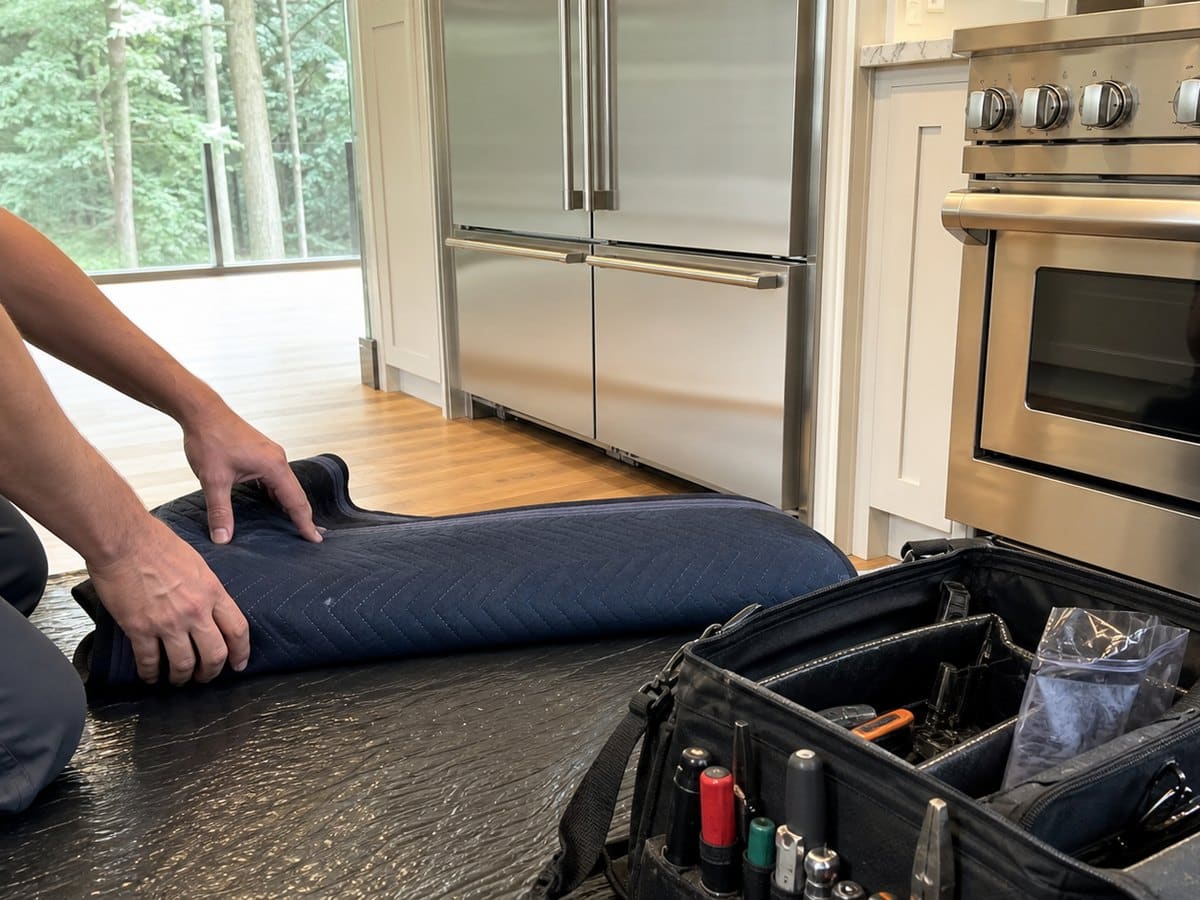
| Cabinet-safe pull-out / reseat support | $215-$975 | 1-4 hours | Applies when panel-ready access, floor protection, water shutoff or two-person staging is needed. |
| Compressor / sealed system | $1,420-$3,475 | 2-6 hours plus parts | Requires pressure/electrical evidence before quoting refrigerant or compressor work. |
Final price is set by the model and serial, cabinet access, verified readings, part revision and whether the first visit proves a part-level repair or sealed-system work.
Planning ranges are estimates; the final quote depends on model, access, diagnosis and part availability.