
Cold-side symptom · Montclair & the Oakland Hills
Sub-Zero Making Noise in Montclair
Buzzing, humming, grinding, or a new click? Each sound points to a different part. Here is how to read it — and how to tell a five-minute cleaning from a real repair.
5.0/5 · 1,225 verified customer reviews
A Sub-Zero earns part of its reputation by being nearly silent, so the day it starts to drone, grind, or rattle, you notice at once — and in Montclair you really notice. Up the canyons off Thornhill Drive, Snake Road, and Colton Boulevard, the houses sit far enough apart that the nights are genuinely still; combine that with the open-plan kitchens nearly every hillside remodel here ended up with, and a refrigerator that runs around the clock is suddenly within earshot of the reading chair with nothing to muffle it.
The reassuring part: a new noise is usually a clue, not a calamity, and the part it points to is often the cheapest one in the box. The trick is reading the sound correctly before anyone reaches for a wrench, because the fix for a dust-loaded fan and the fix for a resonating cabinet panel could not be more different.
Decoding the sound
What each noise is trying to tell you
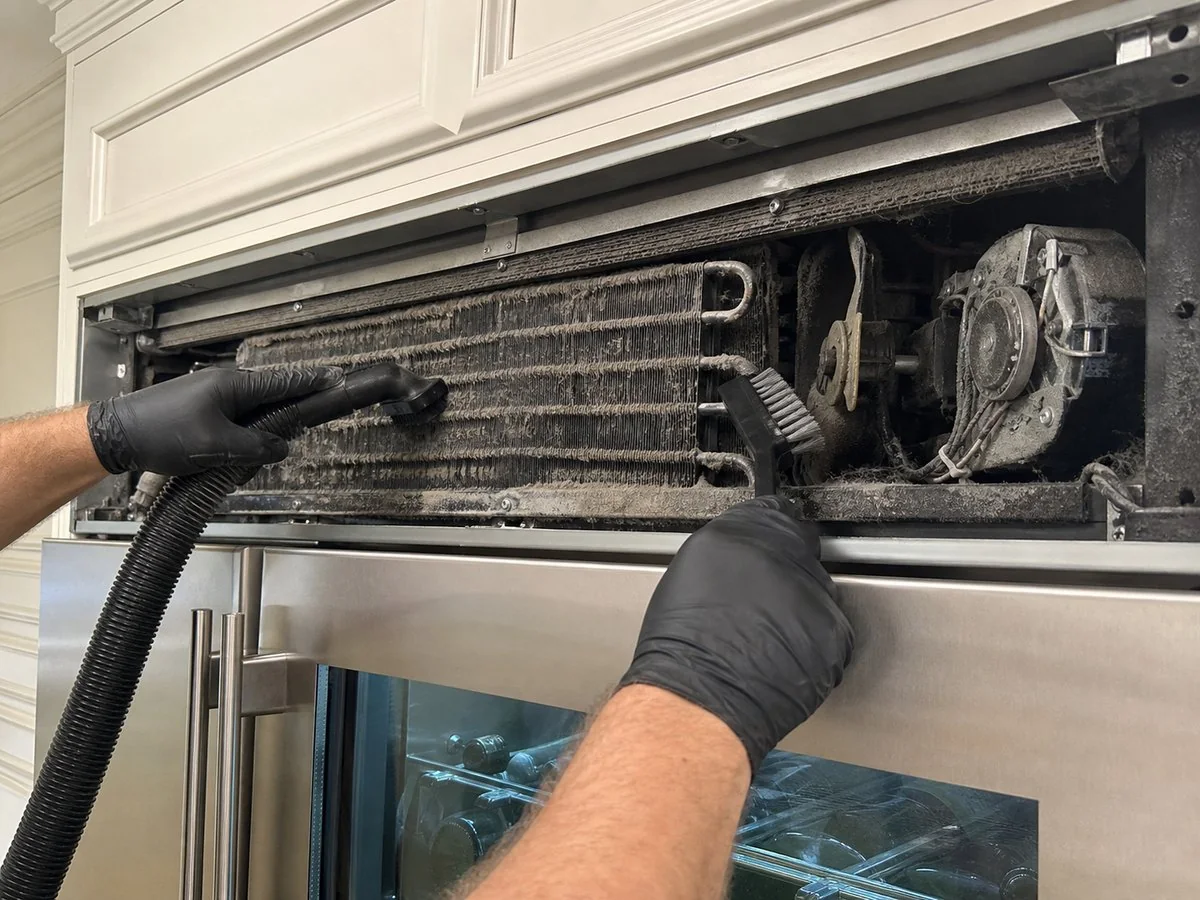
A grinding or whirring from down low. This is the condenser fan behind the lower grille, and in the Oakland Hills it is the single most common offender. The dry-season grit off our eucalyptus and bay-laurel canopy packs the coil and the fan blade; the motor then runs hot, the bearing wears, and you get a whir that builds over weeks. Cleaning plus, often, a fan motor settles it.
A warble or hum from inside. That is the evaporator fan, tucked behind the freezer wall. The giveaway is simple — open the freezer door and the sound vanishes, because the door switch cuts the fan. A frost build-up clipping the blade, or a tired fan motor, is the usual story, and it sometimes travels with a warm spot.
A steady electrical buzz on the compressor's rhythm. A buzz that rises and falls with the cooling cycle is most often a mount, a start relay, or a line touching the cabinet — not the compressor giving out. A genuine compressor fault is real but uncommon, and we prove it before we ever name it.
Sharp clicks and a water-rush on a schedule. Those are the ice maker harvesting and refilling. Normal — unless they come with no ice or a leak, in which case it is the ice maker, not a fault you are hearing.
A loose rattle that stops when you touch it. Resonance. A panel-ready door, a custom trim piece, or the kick grille humming along with the compressor. Common in Montclair's millwork kitchens, and usually a screw, a clip, or a shim away from silent.
Before we arrive
Five quick checks to pin down the noise
- Locate the sound, front versus back. Stand at the front, then crouch by the lower grille. A noise that grows louder at the grille is a condenser-side part; a noise that gets louder when you open the doors is coming from inside, near the evaporator fan.
- Open the freezer and listen for a change. If a hum or warble drops away the instant the freezer door opens, it is the evaporator fan — opening the door cuts power to it. That single test separates two of the most common culprits in seconds.
- Press a hand on the cabinet and the trim. Lightly steady the door panel, the kick grille, and any custom trim. If a rattle or buzz stops under your hand, it is resonance — a loose screw or a panel humming along with the compressor — not a failing part.
- Check the grille for dust and clearance. Peer behind the lower grille. A coil and fan caked in the dry, woody dust common up here will whine and run hot. Make sure nothing stored beside or atop the unit is buzzing in sympathy, too.
- Note when it happens, then call. Tell us whether the sound is constant, cyclical, or only during ice-making, and whether the fridge is still cold. That timing usually narrows the part before we arrive, so the right one rides out on the first visit.
Note what you hear and when. That description alone often tells us which part to load before the visit.
Repair or live with it
When the noise is worth a visit
Plenty of sounds are cosmetic — a rattle you can dampen, the familiar tick of an ice harvest. But a new grinding or screech is worth a prompt look, because a fan that seizes lets the cabinet drift warm, and that turns a modest repair into a food-loss problem. The clearest rule of thumb: if the noise arrives alongside a fridge that is no longer holding temperature, stop waiting and book it. If everything is still cold and the sound quiets under your hand, you have time.
Every visit is the same flat $89 diagnostic, credited toward the repair, with a clear price up front and a 365-day warranty on parts and labor. Because so much hillside noise traces back to a loaded coil, it is worth reading our dust, smoke & airflow maintenance page; if the sound comes with warmth, see not cooling or the sealed-system & compressor page. Cost ranges live on the repair cost page, and our coverage on the service areas map.
Verified reviews
Noise repairs around the Oakland Hills
A low grinding whir started up at night and in our quiet hillside house it was impossible to ignore. He traced it to the condenser fan, packed with the dry dust we get up here, and a worn bearing. Cleaned the coil, swapped the fan motor, and the kitchen went silent again. Knew exactly what he was listening for.
Ours was a hard buzz that came and went. I assumed compressor and braced for bad news. It was actually the panel-ready door trim resonating against a loose screw plus a vibrating water line. Ten-minute fix and an honest no, you do not need a compressor. Charged the diagnostic and that was it.
A warble was coming from inside the freezer — the evaporator fan ticking against a frost build-up. He sorted the defrost issue and the fan, explained why it had started, and pointed me at coil cleaning to keep it quiet. Took a short second visit to confirm, but it held.
FAQ
Noisy Sub-Zero questions
What do the different Sub-Zero noises mean?
Each sound points to a different part. A low grinding or whirring from the lower grille is usually the condenser fan or its bearing. A warble or hum that stops when you open the freezer is the evaporator fan inside. A steady electrical buzz that tracks the compressor cycle can be a mount, a relay, or — rarely — the compressor itself. Sharp clicks on a schedule are the ice maker harvesting. A loose rattle that quiets under your hand is cabinet or trim resonance.
Which noises are urgent and which can wait?
A new grinding or screeching deserves a prompt look, because a failing fan motor that seizes can let the unit run warm. A buzz or rattle you can dampen with a hand, or normal ice-maker clicks, are not emergencies. If the noise comes with a fridge that is drifting warm, treat it as urgent — that pairing can mean airflow has already collapsed.
Why has my Sub-Zero suddenly gotten loud in Montclair?
Two local reasons stand out. First, the dry-season dust off our eucalyptus and bay-laurel canopy — the streets up Shepherd Canyon and toward Skyline are thick with it — packs the condenser coil and loads the fan, which then whines and overworks. Second, so many Montclair kitchens are open-plan and genuinely quiet at night that a sound the unit always made is simply now within earshot of the sofa. We sort out which it is.
Could it be the compressor, and is that expensive?
Possibly, but it is the least likely of the common causes and we never assume it. A true compressor or sealed-system fault needs pressure and electrical proof before anyone quotes it, which is why we diagnose first. Far more often a buzz blamed on the compressor turns out to be a fan, a mount, or a resonating panel. You get a clear price before any work begins, with our 365-day warranty on parts and labor.
Will cleaning the condenser coil fix the noise?
Sometimes on its own, and almost always as part of the fix. A coil and fan loaded with the grit we get in the Oakland Hills is a leading cause of new noise and short-cycling. If the fan motor or bearing is already worn, cleaning alone will not silence it, but it is the maintenance that keeps a quiet unit quiet. See our airflow and dust page for the routine.
Independent appliance-repair service for Montclair and the Oakland Hills. We are not affiliated with, authorized by, or endorsed by Sub-Zero Group, Inc.; Sub-Zero® is a registered trademark of its owner, used here only to describe the appliances we repair.
Put a name to the noise
Describe the sound and when it happens, and we will tell you whether it is a clean-and-go or a part — and bring it with us.