
Cold-side symptom · Montclair & the Oakland Hills
Sub-Zero Freezer Not Freezing in Montclair
Soft ice cream and a freezer that will not hold below frozen — while the fridge side stays cold? That split is the most useful clue you have, and it points to a freezer-side fault, not the whole unit.
4.9/5 · 1,683 verified customer reviews
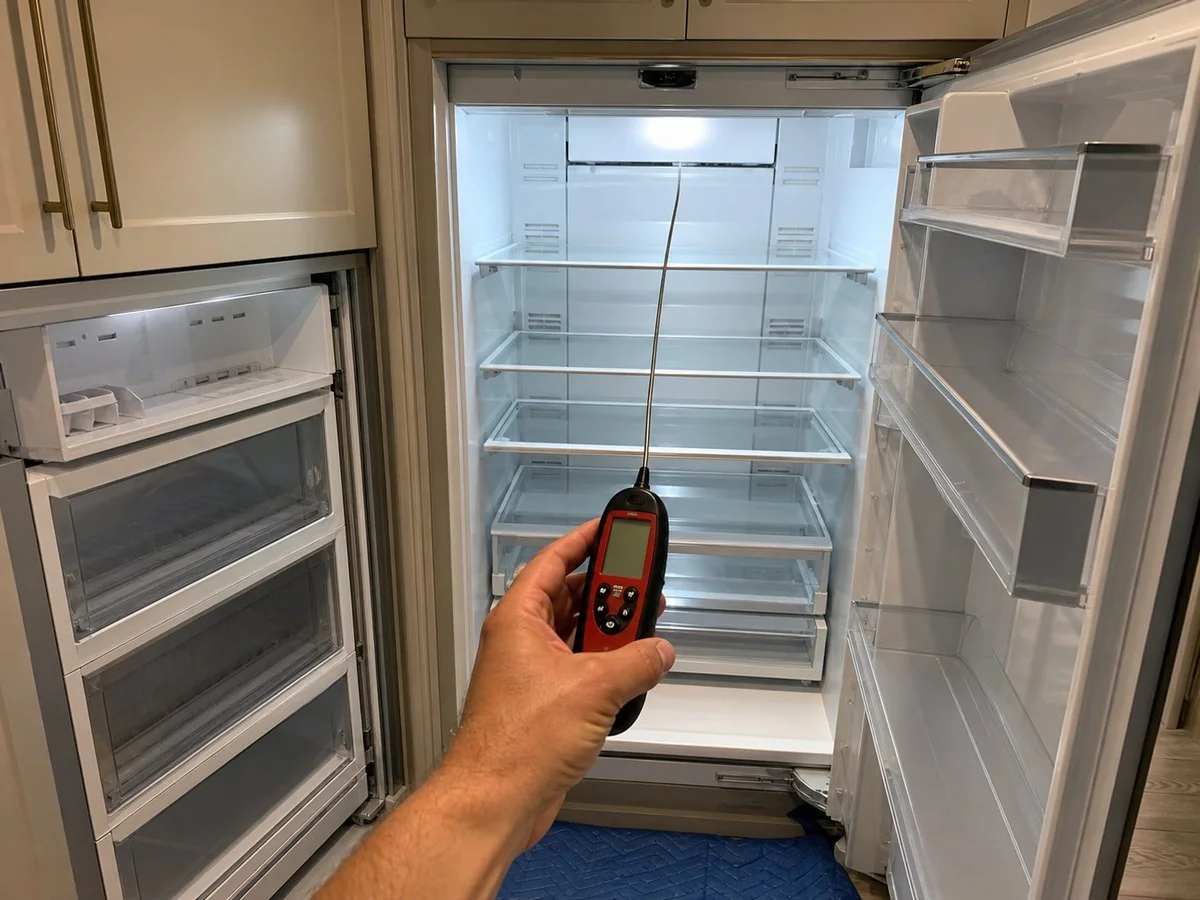
The phrase people use is "the freezer isn't freezing," and what they usually mean is that the ice cream has gone to pudding while the milk a foot away is still cold. That split — freezer warm, fridge fine — is the single most valuable thing you can tell us, because on a Sub-Zero it almost always means a freezer-side fault rather than a problem with the whole machine.
It matters even more in the hills. A great many of the kitchens we work on, especially the homes rebuilt after the 1991 firestorm around Hiller Highlands, Parkwoods, and the Tunnel Road corridor, were fitted with separate built-in freezer columns or undercounter freezer drawers. Those run their own refrigeration loop, independent of the fresh-food side, which is exactly why one can quietly thaw while the other carries on as normal.
The logic behind it
Freezer-warm versus whole-unit-warm
Start with the dual-refrigeration idea, because it is the key to the whole diagnosis. Most modern built-in Sub-Zero units cool the freezer and the fridge with two separate sealed systems and two evaporators. When only the freezer drifts warm, the fault is parked on the freezer's side of the cabinet, and the list is short: a defrost cycle that has stopped, so frost smothers the freezer evaporator and chokes its airflow; a freezer evaporator fan that has stalled or frosted; or, less often, a sealed-system loss on that one loop.
The defrost story is the most common by far. A small heater clears the freezer evaporator on a schedule; when the heater, its bimetal, or the control quits, ice piles up coil by coil until air can no longer move through it. The freezer goes soft even though the compressor is running, which is the counter-intuitive part — it is working, but the cold cannot get out. A bare, dry evaporator with a warm cabinet flips the story toward the sealed system, and that is a different, evidence-first conversation.
Older single-compressor designs behave differently: there, a warm freezer usually drags the fridge warm too, so if both sides are slipping at once we look upstream rather than at the freezer alone. Either way, the pattern you describe tells us which branch of the tree to climb.
Before we arrive
Five checks that point us at the part
- Run the ice-cream test. Ice cream is the most sensitive thing in the box. If it has gone soft or soupy while the fridge side still feels properly cold, you have a freezer-only fault — and that single observation rules out half the possible causes.
- Read the frost line at the back wall. Empty the lower basket and look at the rear interior wall. A solid sheet of frost means the defrost cycle has stopped and ice is smothering the evaporator; bare and dry with a warm cabinet points the other way, toward the sealed system.
- Listen for the inside fan. With the freezer open, the evaporator fan is off, so close the door, wait, and reopen quickly. No air movement and no fan sound when it should be running suggests a stalled or frosted-over fan motor starving the cabinet of cold air.
- Check the door and the drawer seal. On column freezers and undercounter drawers, run a hand around the gasket for a broken seal or a drawer that no longer pulls flush. A leaking seal lets the cabinet creep up and frost form in the wrong places.
- Note any recent power event, then call. Tell us if a PG&E outage or a fire-season shutoff preceded it, and whether the fridge side is still cold. That timeline often points straight to a defrost or control fault and the part we should bring.
A couple of minutes of observation here often decides whether we bring a defrost kit, a fan, or sealed-system gauges.
When to call versus wait
How long can a soft freezer wait?
Not long, honestly. A freezer creeping above frozen is a slow food-safety clock, and once frost has fully bridged the evaporator the unit will keep running without ever recovering on its own — leaving it shut "to see if it sorts itself out" rarely helps and often costs you the contents. If a recent PG&E outage or a fire-season shutoff kicked it off, that is worth saying up front, because a marginal defrost part frequently fails to recover after the power returns. The fix is straightforward once we are there; the waiting is what does the damage.
Every visit is the same flat $89 diagnostic, credited toward the repair, with a clear price before any work and a 365-day warranty on parts and labor. If your pattern is the reverse — warm fridge, cold freezer — read not cooling / warm fridge instead; if the cabinet is bare and warm, see the sealed-system & compressor page. Cost ranges are on the repair cost page, and coverage on our service areas map.
Verified reviews
Freezer repairs around Montclair
Our freezer column slowly went soft — ice cream like pudding — while the fridge side was fine. He explained it was a dual-refrigeration model, so the two sides fail independently, and the freezer's own evaporator had frosted from a defrost fault. Fixed and back to rock-hard in a day.
After a fall power flicker the freezer never quite recovered and stayed too warm. Turned out the defrost heater had failed and a frost wall blocked the airflow. He cleared it, replaced the heater and the bimetal, and walked me through how the recovery is supposed to work. Clear, fair, no upsell.
Undercounter freezer drawer wasn't holding below frozen. He checked the gasket and the drawer seal first, found the evaporator fan stalled, and had the right part on the truck. Tidy work in a tight cabinet and an honest diagnosis up front.
FAQ
Warm-freezer questions
Why is my Sub-Zero freezer not freezing while the fridge is still cold?
On many Sub-Zero built-ins the freezer and the fresh-food side are cooled by separate dual-refrigeration systems, so one can fail while the other works perfectly. A freezer that drifts warm on its own usually means its evaporator has frosted over from a defrost fault — a failed defrost heater, bimetal, or control — or its own fan has stalled. Because the fridge looks fine, people wait too long; the freezer is telling you a specific part has quit.
What is the ice-cream test?
It is the fastest home check. Ice cream softens before anything else in the freezer, so if it has gone to pudding while milk and produce in the fridge are still cold, you are looking at a freezer-only problem rather than a whole-unit one. That distinction changes the entire diagnosis, so it is the first thing we ask about.
Does a power outage cause this in the Oakland Hills?
It can. Fire-season PG&E shutoffs and storm outages are a fact of life up here, and after the power returns a unit with a marginal defrost heater or control sometimes cannot recover — frost builds on the evaporator and the freezer stays soft. The outage did not break the part; it exposed one that was already on its way out. We see this often on the rebuilt hillside homes around Hiller Highlands and Parkwoods.
Is a warm freezer the same problem as a warm fridge?
No, and that is why we keep them separate. A freezer that is warm while the fridge is cold is a freezer-side defrost or fan issue. The opposite pattern — a warm fresh-food side with a cold freezer — is a different fault we cover on its own page. Telling us which way round it is saves a step and points us at the right part.
How much does it cost, and can you reach the hill streets?
A flat $89 diagnostic, credited toward the repair, with a clear price before any work begins and a 365-day warranty on parts and labor. A defrost heater, bimetal, or fan is at the lighter end; a control or sealed-system fault is more involved and only quoted after proof. We cover Montclair Village and the climbing streets toward Skyline, Forest Park, and the Tunnel Road rebuilds in 94611 and 94618.
Independent appliance-repair service for Montclair and the Oakland Hills. We are not affiliated with, authorized by, or endorsed by Sub-Zero Group, Inc.; Sub-Zero® is a registered trademark of its owner, used here only to describe the appliances we repair.
Get the freezer back to rock-hard
Tell us whether the fridge side is still cold and your model number, and we will bring the likely defrost or fan part on the first visit.